Overview
A family of Scandinavian board games, called tafl, where the two sides are deliberately unequal: a king and his defenders try to escape, and a larger force tries to trap him. Hnefatafl is the best-known name.
How far this page is checked. Only one historical description of the rules survives: Carl Linnaeus's account of Tablut, the tafl game he saw played in Lapland in 1732, in Iter Lapponicum. We've checked it in two forms: James Edward Smith's 1811 English translation in Lachesis Lapponica (volume 2), and John C. Ashton's newer translation and analysis in The Heroic Age (2010), made with a professional check of the Latin. They disagree on an important point, set out below. The 11×11 Hnefatafl played today is a modern reconstruction, and its rules vary.
1. Tablut, as Linnaeus recorded it
Pieces: twenty-five in all.
- The king starts on the central square, the royal castle (konokis), which no other piece may enter.
- Eight Swedes, his subjects, start on the squares next to the castle.
- Sixteen Muscovites, the attackers, start four together in the middle of each side of the board, on decorated squares.
Laws (paraphrased):
- Every piece moves in a straight line, not diagonally, as far as it likes across empty squares, and may not jump over other pieces.
- The Swedes and Muscovites take turns. Linnaeus doesn't say who moves first.
- A piece caught between two enemies is killed and removed.
- The king escapes, and the game ends, if he reaches the edge of the board by a clear path. When a path opens, his player calls "raichi", or "tuichu" if two paths are open.
- The king in his castle is taken when attackers hold all four squares around it. If they hold three, he may move out by the fourth.
- The king next to his castle is taken by enemies on his other three sides.
The disputed point: can two pieces capture the king elsewhere?
- Smith's 1811 translation says the two-piece capture applies to every piece "except the King". Most twentieth-century reconstructions followed it, so the king had to be surrounded everywhere.
- Ashton argues the Latin, item Rex, means "likewise the King": away from his castle, the king is captured by two pieces like anyone else, and the four- and three-piece rules above are special cases near the castle. He notes that games played with Smith's reading are badly unbalanced toward the king.
Ashton also points out that Smith left out two of Linnaeus's fourteen entries. The untranslated fourteenth says the decorated squares act like an extra piece: they block movement and can help capture a piece standing next to them. On Ashton's reading, the king also can't escape onto the Muscovites' decorated edge squares.
Linnaeus's text doesn't state the board size, but its figure is a 9×9 board, drawn here from that figure:
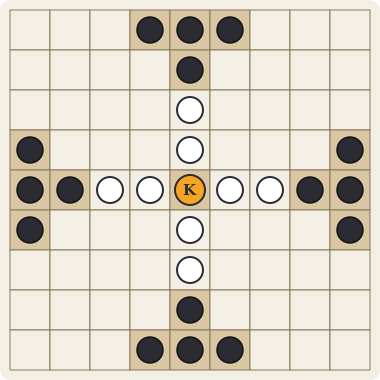
The king is gold, the Swedes white and the Muscovites black. The shaded squares are the ones Linnaeus's figure decorates: the castle and the Muscovites' starting squares.
2. Hnefatafl today (reconstructed)
The popular 11×11 game uses the same ideas:
- Defenders: a king and twelve defenders in a cross around the centre.
- Attackers: twenty-four, in four groups at the middle of each edge.
- Every piece moves like a rook: any distance in a straight line, no diagonals, no jumping.
- Capture by sandwiching a piece between two enemies. Most modern rules make it safe to move your own piece between two enemies, so that the capturing side has to close in. That rule isn't in Linnaeus.
- The throne (the centre) and, in many rule sets, the corners are for the king only, and may count as hostile squares for captures.
Rule sets differ on the points that decide the balance, so agree them first:
- does the king win at a corner or at any edge square?
- must the king be surrounded on four sides, or can he be captured like any other piece?
- can the attackers also win by surrounding all the defenders?
Commonly argued
- The sides are unequal on purpose, with different pieces and goals.
- No diagonal moves, and no jumping.
- In most modern rules, moving between two enemies is safe.
- In Linnaeus's Tablut the king escapes to the edge, not a corner. Many modern Hnefatafl rules use corners instead.
- Can two pieces take the king? Smith's 1811 translation says no. Ashton's reading of the Latin says yes, except on or next to the throne. Agree which you're playing.
Spotted a mistake?
Corrections are reviewed by an editor before they publish.